

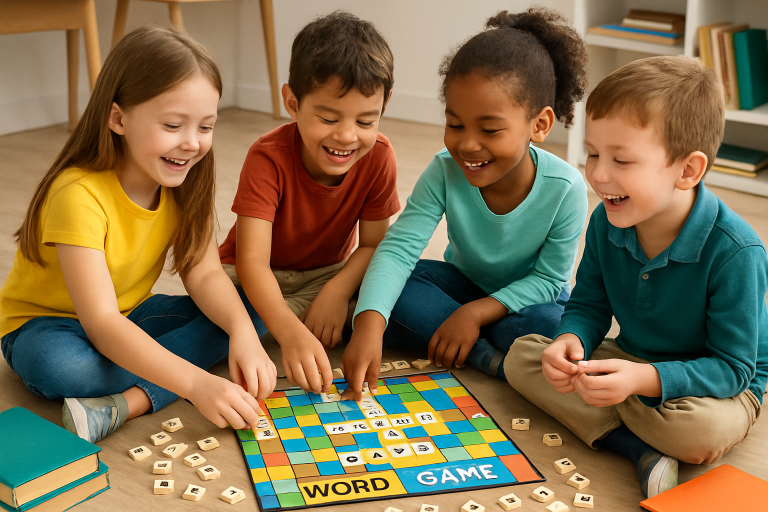
Play isn’t just fun and games. It is a powerful, research-backed tool for developing reading and language skills in young children. Play-based learning creates environments where kids can naturally enhance their literacy abilities, and it lays a crucial, long-lasting foundation for their future academic success. By weaving in resources such as literacy-focused board games, caregivers and educators can transform ordinary playtime into rich, meaningful opportunities for language development, problem-solving, collaboration, and social-emotional development. During play, children become active participants in their learning, practicing the very skills that will support them as future readers and communicators. The simple act of playing, especially when fueled by curiosity and guided by thoughtful adults, can unlock a joy of learning that echoes throughout a child’s life.
Children learn best when they are fully motivated, engaged, and empowered to explore. Nothing draws their attention and inspires curiosity quite like play does. When play is intentionally designed to support literacy growth, children readily build vocabulary, improve their reading comprehension, develop phonological awareness, and master important print concepts, all while having fun. This approach to learning is more than simply enjoyable; it nurtures curiosity, sparks creativity, and reinforces a love of discovery. When children associate these joyful feelings with reading and language, they are more likely to pursue literacy independently, seek out new stories, and become lifelong learners. Creating these positive early connections is vital for healthy brain development and academic achievement.
Understanding Play-Based Learning
Play-based learning describes a flexible, responsive approach that encourages children to explore, experiment, and discover the world around them through self-directed play and hands-on activity. Unlike more structured or didactic lessons, play-based learning places the child’s interests and needs at the center of the experience. Children are offered a variety of materials, situations, and scenarios that naturally spark their curiosity and support literacy and language development. When children make their own choices in play, they exercise creative thinking, learn how to solve problems, and develop independence. The American Academy of Pediatrics emphasizes that play helps build healthy brains, strengthens executive function, and is a powerful context for social and emotional growth. These crucial skills, developed through playful exploration, provide a rich foundation for strong reading and language skills as children grow.
Cognitive Benefits of Play
When children engage in play, they are not only having fun but also practicing and developing essential cognitive skills, including memory, sustained attention, and flexible problem-solving. Activities like building with blocks, assembling puzzles, and engaging in pretend scenarios require children to focus, plan ahead, and adapt their thinking as situations evolve. For example, coordinating pieces in a building game strengthens strategic planning and visual-spatial reasoning, both of which support future reading comprehension. Whether through board games, dramatic play, or cooperative challenges, children routinely make decisions, use logical reasoning, and persevere through setbacks. These flexible cognitive skills directly influence literacy development: children must remember and connect ideas, retain and use new vocabulary, and follow the structure of a story from beginning to end. By nurturing these thinking skills early on, play lays the groundwork for success with reading and language throughout their school years.
Language Development Through Play
Interactive play opens a world of opportunity for children to hear, experiment with, and practice language in authentic contexts. Playful activities such as storytelling, imaginary role-play, and group games encourage children to listen attentively, follow directions, negotiate rules, take turns in conversation, and express their ideas with words. Through these interactions, children develop not only the ability to recognize new words but also the confidence to use them meaningfully. Conversations with others, whether peers or adults, help expand vocabulary, improve comprehension, and support the ability to use language for a variety of purposes. A rich language environment, shaped by responsive caregivers and teachers, is key to early literacy achievement, and regular play gives children the practice they need to flourish.
Play and Phonics
Phonemic awareness, the ability to hear and manipulate individual sounds in spoken words, is a foundational skill for early reading, and it is most effectively developed through playful, interactive experiences. Phonics, or the relationship between letters and sounds, is another cornerstone of literacy. Incorporating games and playful, multi-sensory activities into daily routines makes learning these abstract concepts not only accessible but enjoyable. Rhyming games, for example, sharpen children’s ability to distinguish sound patterns and syllables. Letter-matching activities and singing the alphabet reinforce memory and letter-sound correspondence, making the first steps into decoding less intimidating. Children who play with language in these creative ways develop a strong grasp of the building blocks they need for fluent, independent reading. Repetition, experimentation, and fun are critical when children enjoy these activities; they are more likely to engage regularly and retain what they learn.
Role of Adult Guidance
Adults play a critical role in shaping the educational value of play. When parents, teachers, or caregivers join in and participate, they can scaffold children’s learning by asking open-ended questions (“What do you think will happen next?”), introducing new vocabulary and modeling effective communication. Guided play—a blend of child-led discovery and thoughtful adult input—has been found to yield especially powerful outcomes for language and literacy. Rather than directly instructing or taking over, adults provide just enough support to extend learning and foster independence. This approach makes play both enjoyable and intellectually stimulating, ensuring that children are challenged but not overwhelmed. In addition, adults can use play as an opportunity to observe what draws children in, assess their strengths and needs, and offer targeted support. By intentionally engaging in children’s play, adults help create language-rich environments that inspire confidence and a lifelong love of reading and communication.
Practical Ways to Incorporate Play
- Storytelling Games: Invite children to invent, tell, and act out their own stories using puppets, drawings, or props. This builds narrative understanding, expressive language, and creativity simultaneously.
- Letter Hunts: Organize playful scavenger hunts where children search for objects that begin with specific letters or sounds, reinforcing letter recognition, phonemic awareness, and observation skills.
- Role-Playing: Create pretend scenarios like a grocery store, restaurant, or post office to encourage children to read labels, menus, and everyday signs, bringing print to life in familiar environments.
- Board Games: Choose games that require players to follow instructions, describe actions, or tell stories. These games not only support reading comprehension and vocabulary but also social cooperation and turn-taking skills.
Balancing Digital and Physical Play
In today’s world, digital games and educational apps can be powerful tools for reinforcing literacy concepts, but they should be thoughtfully balanced with hands-on, in-person play. Studies show that physical play, such as building, acting, or participating in group games, is more effective than digital play alone for developing reading skills in young children. Screens can offer structured practice and engagement, yet real conversation, movement, and face-to-face interaction facilitate more complex language growth and social development. Caregivers should be intentional in selecting digital resources aligned with evidence-based literacy practices, using them to supplement, not replace, physical play. Prioritizing language-rich activities away from screens helps children practice communication, build vocabulary, and connect emotionally with others. According to Edutopia, balancing screen time with active play is crucial to maximizing cognitive and language growth in early childhood.
Conclusion
Integrating play into literacy-building strategies is a proven, powerful way to help children become confident, motivated readers and successful communicators. When parents, educators, and caregivers intentionally combine guided and free play, they create environments rich in language experiences and tailored learning opportunities. Whether it involves storytelling, imaginative adventures, board games, or everyday conversation, play unlocks children’s potential and fosters a true love of language. By valuing, encouraging, and enriching play, we not only help children develop the skills they need for lifelong literacy success but also nurture the joy and curiosity that make learning a lifelong journey.