

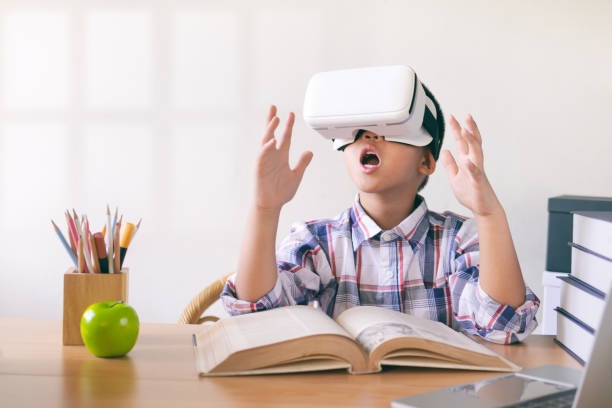
Imagine walking through ancient Rome, exploring the human bloodstream, or conducting complex science experiments — all without leaving your classroom. With Virtual Reality (VR), these immersive learning experiences are not just possible — they’re transforming how we teach and learn.
Virtual Reality in education bridges the gap between theory and experience, offering students a deeper, more interactive form of engagement. Here’s how VR is reshaping education and enhancing learning across all levels.
What Is Virtual Reality in Education?
Virtual Reality (VR) is a simulated, computer-generated environment that users can interact with using headsets and motion controllers. In education, VR allows students to experience learning in a 3D environment that replicates real-life scenarios or abstract concepts, making education immersive, interactive, and memorable.
Benefits of VR in the Learning Process
1. Enhanced Engagement
VR captures students’ attention by placing them at the center of the learning environment. This leads to better focus, higher interest, and more active participation.
2. Experiential Learning
VR enables students to learn by doing — a method proven to increase retention. From virtual chemistry labs to 3D geometry, VR turns passive learning into active exploration.
3. Access to Otherwise Inaccessible Content
Students can tour historical landmarks, visit outer space, or practice surgeries — all of which would be impossible or impractical in a traditional classroom.
4. Safe Simulation of Risky Scenarios
VR provides a controlled environment to simulate dangerous or high-risk situations, such as flight training, emergency response, or chemical experiments.
5. Personalized Learning
VR can adapt to individual learning speeds and styles, offering self-paced environments where students can revisit lessons or practice as needed.
Applications of VR Across Education Levels
- K–12 Education: Interactive storytelling, field trips, and science labs that boost curiosity and creativity.
- Higher Education: Medical simulations, architectural walkthroughs, and historical reenactments for hands-on practice.
- Vocational Training: Skill-building in areas like welding, healthcare, or engineering with realistic, risk-free simulations.
- Special Education: Tailored experiences for students with learning disabilities or sensory sensitivities.
Popular VR Tools in Education
- Google Expeditions – Virtual field trips to hundreds of destinations.
- zSpace – Combines VR and AR for STEM learning in classrooms.
- Labster – Virtual science labs for biology, chemistry, and physics.
- Unimersiv – VR educational content covering history, space, and anatomy.
Challenges and Considerations
- Cost of Hardware: VR headsets and compatible devices can be expensive, especially for schools with limited budgets.
- Training for Educators: Teachers need proper training to integrate VR effectively into their lessons.
- Content Availability: VR education content is still growing, and some subjects may have limited resources.
- Accessibility: Not all students may have the physical ability or equipment access to use VR comfortably.
The Future of VR in Education
As VR technology becomes more affordable and accessible, its role in education will continue to expand. Future advancements may include:
- AI-driven adaptive VR learning
- Full classroom VR integration
- Real-time collaboration in virtual spaces
The goal is clear: to create immersive, student-centered learning environments that enhance understanding, spark curiosity, and prepare students for real-world challenges.
Final Thoughts
Virtual Reality is not a gimmick — it’s a powerful tool that brings lessons to life. By making learning more engaging, accessible, and interactive, VR is set to revolutionize classrooms around the world. As schools and institutions adopt this technology, the learning experience will become more immersive, impactful, and future-ready.